Theory
FCFS
- FCFS stands for First Come First Served.
- As the name suggests, this algorithm entertains requests in the order they arrive in the disk queue.
- It is the simplest disk scheduling algorithm.
Advantages
- It is simple, easy to understand and implement.
- It does not cause starvation to any request.
Disadvantages
- It results in increased total seek time.
- It is inefficient.
SSTF
- SSTF stands for Shortest Seek Time First.
- This algorithm services that request next which requires least number of head movements from its current position regardless of the direction.
- It breaks the tie in the direction of head movement.
Advantages
- It reduces the total seek time as compared to FCFS.
- It provides increased throughput.
- It provides less average response time and waiting time.
Disadvantages
- There is an overhead of finding out the closest request.
- The requests which are far from the head might starve for the CPU.
- It provides high variance in response time and waiting time.
- Switching the direction of head frequently slows down the algorithm.
currentTracks = [53, 50]
requestArrays = [[176, 79, 34, 60, 92, 11, 41, 114],
       [4, 34, 10, 7, 19, 73, 2, 15, 6, 20],
       [98, 183, 41, 122, 14, 124, 65, 67]]
Algorithm for FCFS
- Let Request array represents an array storing indexes of tracks that have been requested in ascending order of their time of arrival.
headis the position of disk head.- Let us one by one take the tracks in default order and calculate the absolute distance of the track from the head.
- Increment the total seek count with this distance.
- Currently serviced track position now becomes the new head position.
- Go to step 3 until all tracks in request array have not been serviced.
def fcfs(array: list, start: int, log = False) -> int:
    rotations = 0
    current = start
    for i in array:
        value = abs(i - current)

        # TODO: print log statements
        if log: print(f'|{i} - {current}| = {value}')
        current = i; rotations += value
    return rotations
Algorithm for SSTF
- Let the Request array represents an array storing indexes of tracks that have been requested.
headis the position of the disk head.- Find the positive distance of all tracks in the request array from the head.
- Find a track from the requested array which has not been accessed/serviced yet and has a minimum distance from the head.
- Increment the total seek count with this distance.
- Currently serviced track position now becomes the new head position.
- Go to step 3 until all tracks in the request array have not been serviced.
def sstf(array: list, start: int, isUpDirection = True, log = False) -> (int, list):
    rotations = 0
    current = start
    auxillaryArray = array[:]
    seekSequence = []

    new_current = current
    previousHeadMovement = isUpDirection # True = up, False = down (default)

    while len(auxillaryArray) > 0:
        min_rotations = float('inf')
        currentHeadMovement = previousHeadMovement

        for i in auxillaryArray:

            value = i - current

            if abs(value) < min_rotations:

                if value < 0: currentHeadMovement = True
                else: currentHeadMovement = False

                min_rotations = abs(value)
                new_current = i
            elif value == min_rotations:
                if currentHeadMovement == previousHeadMovement: new_current = i

        previousHeadMovement = currentHeadMovement

        # TODO: print log statements
        if log: print(f'|{new_current} - {current}| = {min_rotations}')

        current = new_current; rotations += min_rotations
        auxillaryArray.remove(current)
        seekSequence.append(current)
    return rotations, seekSequence
Questions
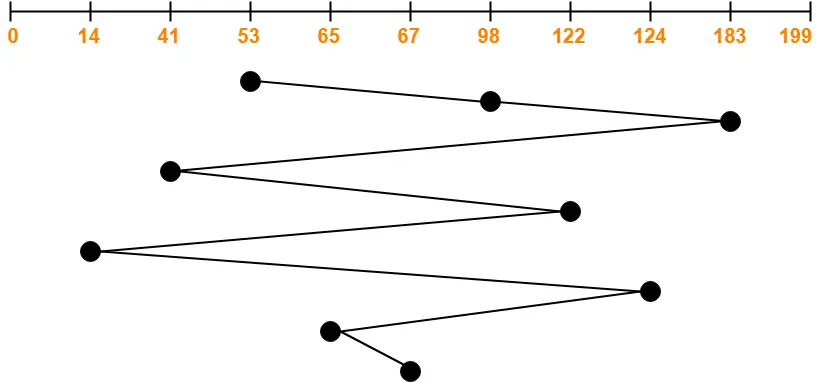
Q1. Consider a disk queue with requests for I/O to blocks on cylinders $\ 98, 183, 41, 122, 14, 124, 65, 67 \ $. The FCFS scheduling algorithm is used. The head is initially at cylinder number 53. The cylinders are numbered from 0 to 199. The total head movement (in number of cylinders) incurred while servicing these requests is _______
print(f'Total number of head movements = {fcfs(requestArrays[2], currentTracks[0], log = True)}')
|98 - 53| = 45
|183 - 98| = 85
|41 - 183| = 142
|122 - 41| = 81
|14 - 122| = 108
|124 - 14| = 110
|65 - 124| = 59
|67 - 65| = 2
Total number of head movements = 632
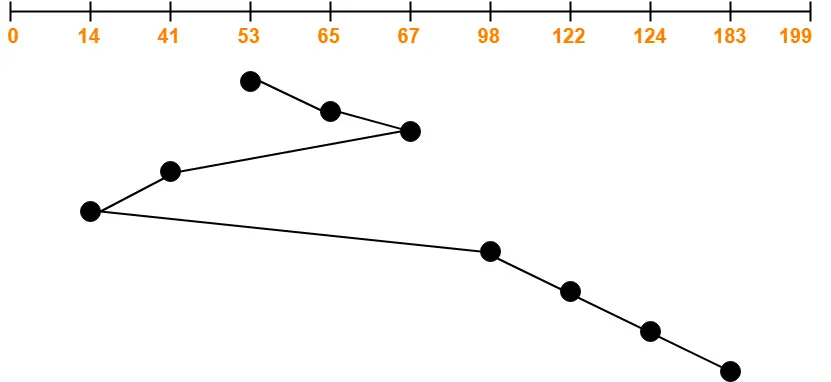
Q2. Consider a disk queue with requests for I/O to blocks on cylinders $\ 98, 183, 41, 122, 14, 124, 65, 67\ $. The SSTF scheduling algorithm is used. The head is initially at cylinder number 53 moving towards larger cylinder numbers (UP direction) on its servicing pass. The cylinders are numbered from 0 to 199. The total head movement (in number of cylinders) incurred while servicing these requests is _______
rotations, seek_sequence = sstf(requestArrays[2], currentTracks[0], log = True)
print(f"Total number of head movements = {rotations}\nSeek sequence: {', '.join(map(str, seek_sequence))}")
|65 - 53| = 12
|67 - 65| = 2
|41 - 67| = 26
|14 - 41| = 27
|98 - 14| = 84
|122 - 98| = 24
|124 - 122| = 2
|183 - 124| = 59
Total number of head movements = 236
Seek sequence: 65, 67, 41, 14, 98, 122, 124, 183
Q3. Consider a disk system with 100 cylinders. The requests to access the cylinders occur in following sequence-
$$4, 34, 10, 7, 19, 73, 2, 15, 6, 20$$
Assuming that the head is currently at cylinder 50, what is the time taken to satisfy all requests if it takes 1 ms to move from one cylinder to adjacent one and shortest seek time first policy is used?
- 95 ms
- 119 ms
- 233 ms
- 276 ms
rotations, seek_sequence = sstf(requestArrays[1], currentTracks[1], log = True)
print(f"Total number of head movements = {rotations}\nSeek sequence: {', '.join(map(str, seek_sequence))}")
|34 - 50| = 16
|20 - 34| = 14
|19 - 20| = 1
|15 - 19| = 4
|10 - 15| = 5
|7 - 10| = 3
|6 - 7| = 1
|4 - 6| = 2
|2 - 4| = 2
|73 - 2| = 71
Total number of head movements = 119
Seek sequence: 34, 20, 19, 15, 10, 7, 6, 4, 2, 73
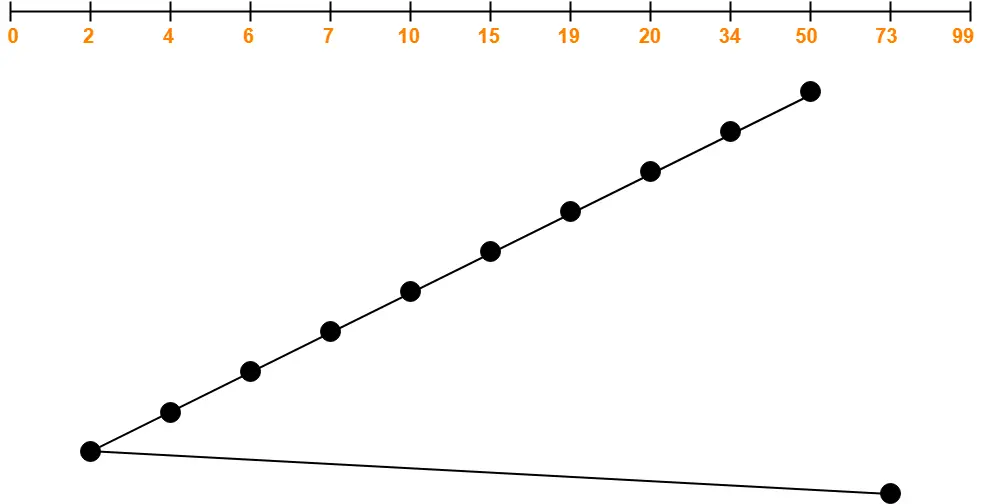
$\therefore$ Time required for $119$ head movements $=119\times 1=\boxed{119\ ms}$
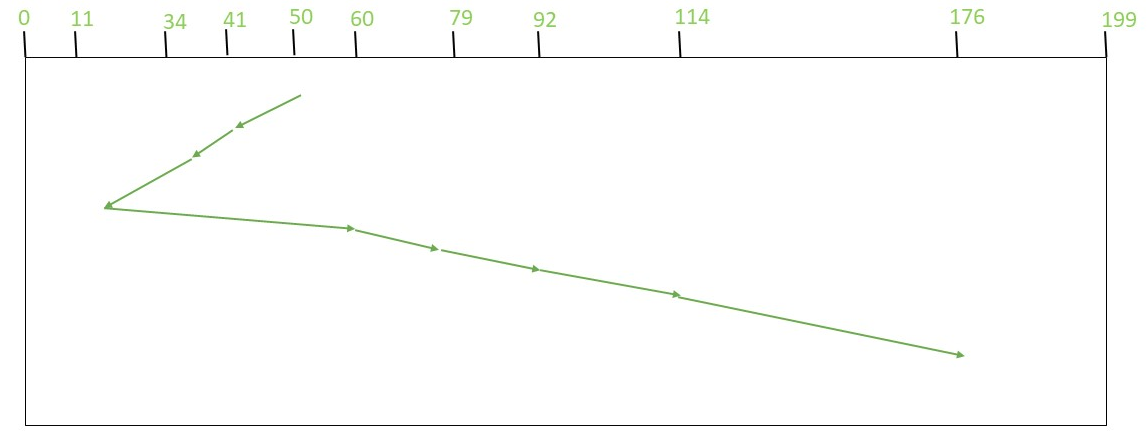
Q4. Consider a disk queue with requests for I/O to blocks on cylinders $\ 176, 79, 34, 60, 92, 11, 41, 114\ $. The SSTF scheduling algorithm is used. The head is initially at cylinder number 50 moving towards larger cylinder numbers (UP direction) on its servicing pass. The cylinders are numbered from 0 to 199. The total head movement (in number of cylinders) incurred while servicing these requests is _______
rotations, seek_sequence = sstf(requestArrays[0], currentTracks[1], log = True)
print(f"Total number of head movements = {rotations}\nSeek sequence: {', '.join(map(str, seek_sequence))}")
|41 - 50| = 9
|34 - 41| = 7
|11 - 34| = 23
|60 - 11| = 49
|79 - 60| = 19
|92 - 79| = 13
|114 - 92| = 22
|176 - 114| = 62
Total number of head movements = 204
Seek sequence: 41, 34, 11, 60, 79, 92, 114, 176